VARUNAKULATTAN
BEYOND “A COMMANDER AGAINST THE PORTUGUESE”
Tamil Maritime Resistance, Coromandel Memory and an Under-recognised Hero
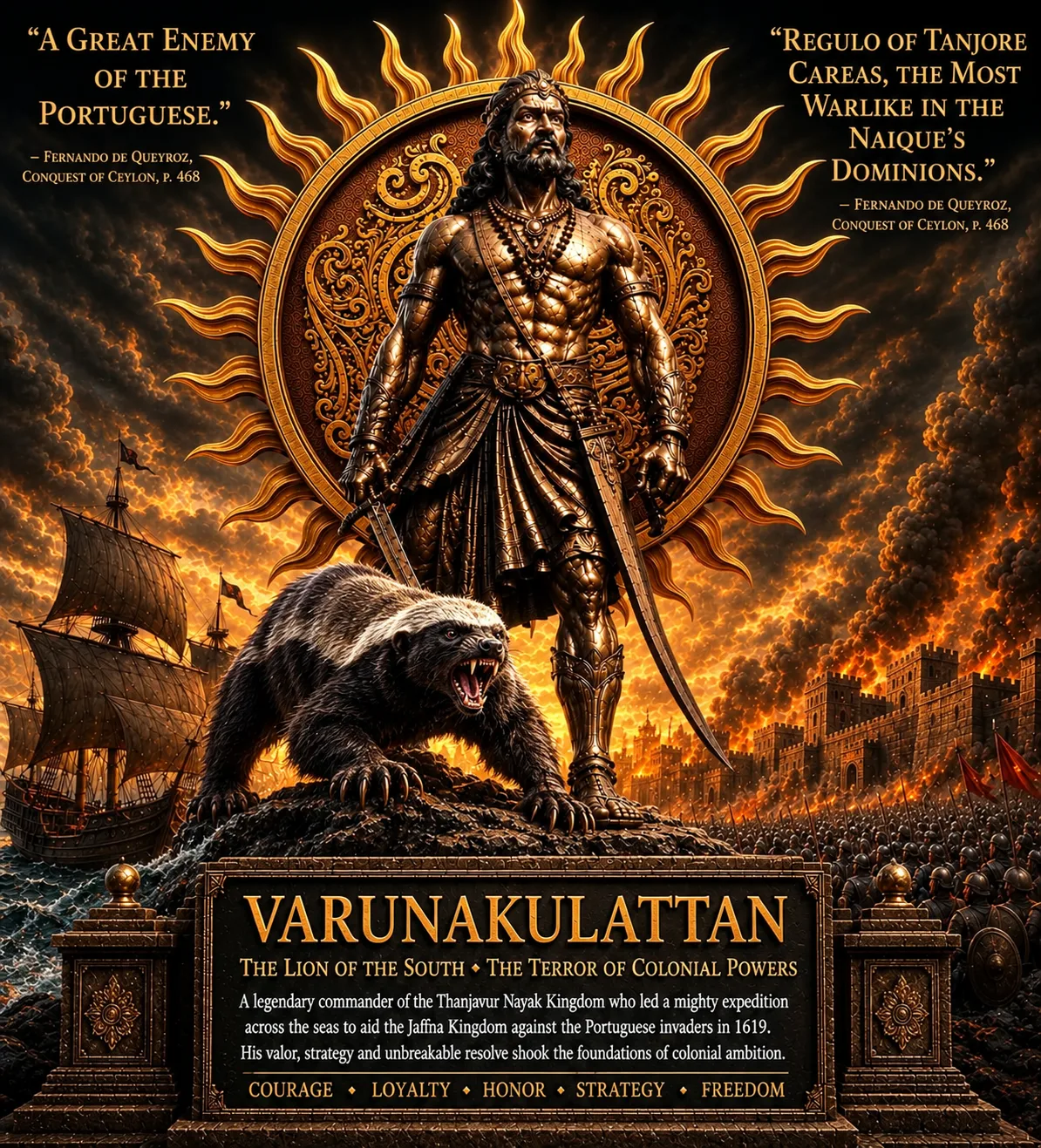
Varunakulattan is often introduced simply as a commander who was sent by the Thanjavur Nayak ruler to assist the king of Jaffna against the Portuguese.
But the historical record allows us to see a much larger picture.
A figure who deserves a wider historical place
Varunakulattan, also recorded as Khem Nayak / Chem Nayak, was a major military leader associated with the Thanjavur Nayak state during the early seventeenth-century struggle against Portuguese expansion.
Portuguese historical accounts themselves provide unusually strong testimony about his reputation.
He is described as a “great enemy of the Portuguese” and as “the most warlike in the Naique’s dominions.”
These descriptions are important because they come from the historical record of the very colonial power against which he fought.
He therefore deserves to be remembered as more than merely “a commander who went to Jaffna.”
His story did not begin with the fall of Jaffna
The confrontation between the Thanjavur Nayak state and Portuguese power in the Tamil maritime region was already developing before the decisive events of 1619.
Historical accounts record that Nagapattinam was attacked by the Nayak in 1617, and that many Portuguese fled to Kochi on 15 March 1617. The same historical account then records an army of 1,000 men led by Varunakulathan.
This places Varunakulattan within a wider military confrontation with Portuguese power on the Tamil coast—not merely within the later Jaffna campaign.
The Jaffna campaign made him historically significant
When Cankili II, the ruler of Jaffna, sought assistance from the Thanjavur Nayak, a substantial force was sent under Varunakulattan.
The Portuguese conquest of Jaffna in 1619 did not immediately end the resistance.
The Thanjavur forces continued to play a role in the subsequent struggle, and historical accounts record further military operations in 1620–1621.
This makes Varunakulattan important not only in the story of Jaffna, but in the larger history of Tamil maritime resistance to Portuguese expansion across the Palk Strait and the Coromandel region.
“Shark of the Bay of Bengal” — history and living memory
The expression “Shark of the Bay of Bengal” should be treated carefully.
There is not enough evidence to claim that this was a documented seventeenth-century Portuguese title for Varunakulattan.
However, the expression has significance in Coromandel coastal oral memory and later Tamil commemorative tradition. Such traditions should not simply be dismissed because they are not found in contemporary European records.
Historical memory can survive through communities, oral traditions and cultural remembrance even when the original documentary evidence is limited.
Therefore, the responsible approach is to distinguish:
documented historical titles from later or living traditional epithets—without erasing either.
Why Varunakulattan matters to Tamil history
The early seventeenth century was a critical period for the Tamil maritime world.
Portuguese power was expanding along the coast and into Sri Lanka. The fall of Jaffna, the Portuguese presence around the Gulf of Mannar and the wider expansion of Portuguese political, commercial and religious influence transformed the maritime environment of the region.
In this context, Varunakulattan represents an important but still under-recognised chapter of Tamil military and maritime resistance to European colonial expansion.
His story connects:
Thanjavur → Nagapattinam → the Coromandel Coast → Palk Strait → Jaffna
This is why his history should not be confined to a single expedition.
Why he matters to Tamil Hindu historical memory
Varunakulattan also occupies a meaningful place in the historical memory of the Tamil maritime communities whose world was being transformed by Portuguese expansion.
His story belongs to a period when political sovereignty, maritime power, trade, religion and military resistance were deeply interconnected.
Remembering him does not require inventing facts or turning folklore into documentary evidence.
Instead, it requires bringing together:
archival evidence + Portuguese accounts + modern scholarship + Tamil coastal memory.
That is how a forgotten historical figure can be restored to his rightful place without compromising historical integrity.
Varunakulattan and Kunjali Marakkar are not the same story
Varunakulattan should also not be reduced to a Tamil version of Kunjali Marakkar.
Both belong to the history of resistance against Portuguese maritime expansion, but they emerged from different political environments, regions and historical circumstances.
Kunjali Marakkar belongs primarily to the Zamorin–Malabar maritime world.
Varunakulattan belongs to the Thanjavur–Coromandel–Jaffna political and maritime sphere.
Their stories are complementary—not interchangeable.
A stronger historical description
Rather than describing Varunakulattan simply as:
“A commander against the Portuguese,”
a fuller description would be:
“Varunakulattan, also recorded as Khem Nayak or Chem Nayak, was a major military leader associated with the Thanjavur Nayak state during the struggle against Portuguese expansion in the Tamil maritime region and Jaffna in the early seventeenth century. Portuguese historical accounts described him as a ‘great enemy of the Portuguese’ and as ‘the most warlike in the Naique’s dominions.’ His role extended beyond the 1619 Jaffna campaign into the wider Thanjavur–Portuguese conflict and the continued resistance of 1620–21.”
Varunakulattan was not merely a commander who crossed the sea to Jaffna.
He represents a much larger and still under-recognised chapter of Tamil maritime history, military resistance and the struggle against Portuguese expansion.
His history deserves to be studied, documented and remembered with both scholarly accuracy and respect for Tamil historical memory.

 All posts →
Comments
Log in to commentNo comments yet. Start the conversation.