The Real Cost of Being Cheap: India's Hidden World of Fake Goods
India's hidden world of counterfeit goods

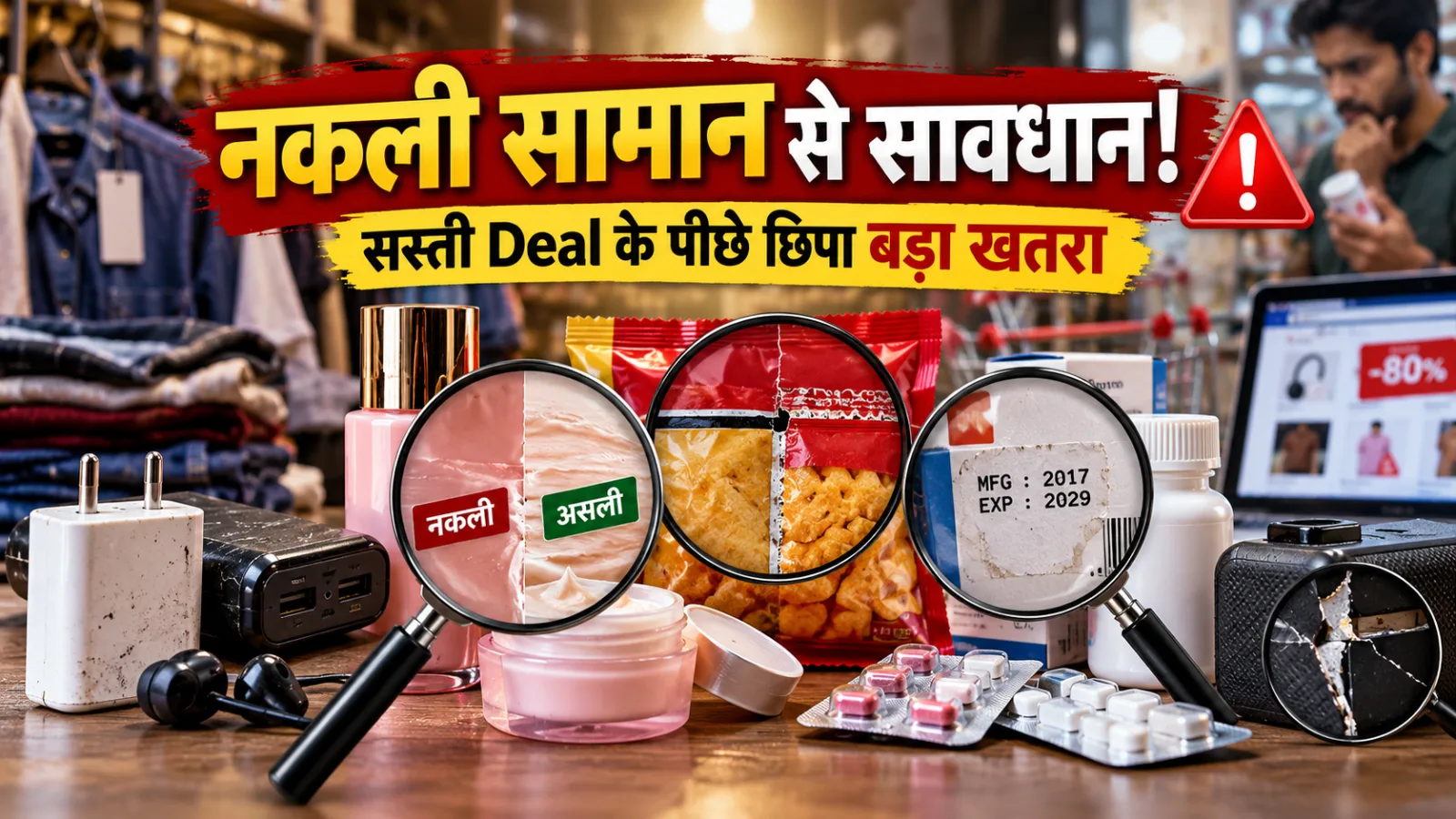
₹600 item for just ₹60. ₹230 product for ₹23. Branded perfumes, creams, shampoos, electronics, and even food and drinks at 80–90% discount.
This sounds like an amazing sale. But if a product is being sold at a price so low that it's hard to believe, maybe the question isn't just "How can it be so cheap?"
The real question should be—
"Is this product genuine?"
Today, the market for counterfeit products isn't limited to fake clothes, shoes, or watches. The transcript describes a market where cosmetics, electronics, packaged food, automobile products, and medicines are claimed to be sold as fake copies.
This problem affects not just your money, but also your health and safety in many cases.
Counterfeit products are no longer just "First Copy"
There was a time when a counterfeit product usually meant a fake T-shirt, shoes, or bag from an expensive brand.
You would go to a local market, buy a branded shirt that looked like it cost ₹2,000 for ₹200, and you'd know it wasn't original.
But the problem becomes serious when counterfeit products are sold as genuine.
Today, the counterfeit market can include items that an average customer can't easily tell apart from the real thing.
The packaging is the same.
The logo is almost the same.
The font is the same.
The color combination is the same.
Even the QR code can be copied.
And the customer has no way to conduct a forensic examination of every product while standing in the store.
Fake Electronics: Cheap Deal or Expensive Damage?
On online marketplaces, you often see memory cards, earphones, speakers, chargers, and power banks from big brands at very low prices.
Let's say you find a 128 GB or 256 GB memory card at a very cheap price.
You buy it.
After putting it in your phone, it shows 128 GB.
But as explained in the transcript, some fake storage devices can actually be only 4 GB or 8 GB, and their software information is changed to make them appear as having more capacity. Everything may seem normal for some time, and then problems like data corruption can occur.
The danger increases with chargers, power banks, and earphones.
The product may look original from the outside, but if low-quality batteries, wiring, or components are used inside, problems like overheating, short circuits, or battery failure can occur.
Therefore, it's not enough to trust electronics just by looking at the logo and packaging.
Cosmetics: Will Your Face Glow or Will Your Skin Get Damaged?
Counterfeit cosmetics can be the most worrying part of this market.
Fake cream, lipstick, lotion, perfume, soap, and face wash—duplicate packaging can be made for any popular product.
The transcript claims that some fake cosmetic products are made with very cheap ingredients and may also contain harmful substances.
Think about it—
You are getting an expensive facial done at a salon.
You are told that a premium branded cream is being used.
But if the salon operator has bought very cheap counterfeit products, it may be almost impossible for the customer to identify them.
Such products can cause skin irritation, allergy, or other problems.
So, in cosmetics, “getting a cheap deal” is not always good news.
The danger has reached even food
Cosmetics are used on the outside of the body.
But food goes directly into your body.
This is where the problem of counterfeit and adulteration becomes more serious.
The transcript gives examples of fake or adulterated goods in juice, packaged water, milk, paneer, ghee, spices, sweets, and everyday packaged foods.
Sometimes, fake products have names that are very similar to the original brand, so customers can be easily fooled.
One letter is changed.
The logo is slightly changed.
The color is kept the same.
The packaging is made almost identical.
The customer looks at the product for two seconds in the store and thinks they have bought the same familiar brand.
During festivals, the demand for sweets, khoya, mawa, ghee, and dairy products increases, which raises concerns about adulteration.
So, just looking at the brand name is not enough. You also need to check the packaging and manufacturer information.
The most dangerous level: counterfeit medicines
If you buy a fake shirt, you lose money.
If you buy a fake charger, your device can get damaged.
If you buy a fake cosmetic, you can have a skin reaction.
But if the medicine is fake?
This can be a matter of life and death.
The transcript considers counterfeit medicines to be one of the most serious parts of this problem and gives examples of health risks from fake or substandard medicines.
Medicine is something that a normal customer can't verify by looking at it.
The tablet's color might be right.
The strip might look like the original one.
The logo, batch number, and printing might also look trustworthy.
But what's the actual composition inside? It's not possible for a regular customer to find out without laboratory testing.
That's why it's very important to buy medicines from a reputable and authorized pharmacy.
How is counterfeit goods made and sold?
The counterfeit business is not just about making a copy of a product and selling it.
The transcript explains several possible ways to do this.
One way is to buy rejected or expired stock.
Remove the old date.
Put on a new sticker.
Prepare new packaging.
And then sell it back in the market.
The second way is to copy the entire visual identity of the original product - logo, font, colors, box design, and even the QR code.
The third way is even more clever.
Fake products are not called “fake”.
They are given new attractive names—
First Copy
Premium Copy
Master Copy
Mirror Copy
Or they are said to be—
“Dubai stock.”
“Vietnam stock.”
“Customs seized it, so it's cheap.”
The transcript also mentions methods like mixing original and fake products in the same consignment to sell them.
As soon as the marketing language changes, the customer starts to feel that they are not buying a fake product, but something from a special category.
This psychology is one of the greatest strengths of the counterfeit market.
Why has online shopping made the problem even more difficult?
In a physical market, the product is at least in front of you.
You can see the packaging.
You can feel the quality.
You can ask the shopkeeper questions.
But in online shopping, you don't see the product—you see its photo.
The seller doesn't show the product—they show the listing.
This is where counterfeit sellers get a new way.
Professional photographs, attractive titles, heavy discounts, and some positive reviews can be enough to make a product look genuine.
The transcript also expresses concern about counterfeit trade spreading to online platforms and third-party sellers.
This does not mean that every discounted product found online is fake.
Big sales, clearance sales, festival offers, and legitimate discounts are completely real.
The problem is when an unreliable seller has an offer that seems impossible compared to the normal market price.
Fake goods do not just harm the customer
The loss of the counterfeit economy is not limited to the person who bought the fake product.
It has many levels.
The first loss is to the customer.
Money is lost.
The product turns out to be bad.
And in the dangerous category, there is a separate health or safety risk.
The second loss is to genuine businesses.
A company spends money on research, manufacturing, quality control, packaging, distribution, and taxes to make a product.
On the other hand, someone makes a copy of the same branding and sells the product at a very low price.
The honest business cannot compete with that price.
The transcript discusses the health, business, and tax-related effects of counterfeit trade, highlighting this problem.
In the long run, the most dangerous result of this could be that honest business seems expensive and dishonesty seems more profitable.
How to identify if a product could be fake?
There is no single method that gives a 100% guarantee, but some red flags can alert you.
First, look at—
Is the price too low?
If someone is selling a product that normally costs ₹5,000 for ₹500, then question it before buying.
Check the packaging.
Is there a spelling mistake?
Is the logo slightly different?
Is the color shade mismatched?
Is the printing blurry or crooked?
Is the manufacturing or expiry date part scratched or re-stickered?
Does the packaging material seem unusually cheap?
The transcript also advises paying attention to such packaging-related warning signs and buying from verified sellers.
What to do for safe shopping?
Buy expensive products from an authorised brand store or authorised dealer as much as possible.
If buying online, give priority to the brand's official website or authorised seller.
Always buy medicines from a reputed medical store or trusted pharmacy.
Be cautious of unbelievable deals found on social media.
Do take an invoice.
After receiving the product, check the packaging, seal, batch number, and manufacturing details.
And most importantly—
Before getting excited about a "Too Good To Be True" deal, ask questions.
If a businessman is selling a genuine item worth ₹600 for ₹60, it is essential to understand where the remaining ₹540 have gone.
Sometimes the answer might be a genuine clearance sale.
But sometimes the answer might be a counterfeit product.
Whose responsibility is it ultimately?
An average customer cannot get every product laboratory tested.
They cannot check the chemical composition of every medicine.
They cannot do independent testing of the ingredients of every cosmetic.
And they cannot open every electronic device to verify its components.
Therefore, the real responsibility to stop counterfeit products also lies with regulatory agencies, manufacturers, marketplaces, sellers, and the enforcement system.
But until there is strong enforcement at every level, consumer awareness is extremely important.
Being cautious is not paranoia.
This is smart consumer behaviour.
Conclusion
The market for fake goods is not just a story of buying "cheap branded goods".
This is a problem of consumer trust.
When a person deliberately buys a first-copy shoe for ₹500, he at least knows what he is buying.
But when a customer pays the full price for an original product and is handed a fake cosmetic, charger, food item, or medicine - then it is not just business, it is cheating.
So the next time you come across a deal that looks like -
"It's so cheap? I've hit the jackpot today!"
Then before buying, just stop for ten seconds and ask -
Am I really saving money, or am I paying a much bigger price in the pursuit of cheapness?
Because many times the most expensive thing is -
What appears to us as the cheapest.
 All posts →
Comments
Log in to commentNo comments yet. Start the conversation.