Who are the real creators of India?
Who are the real creators of India?

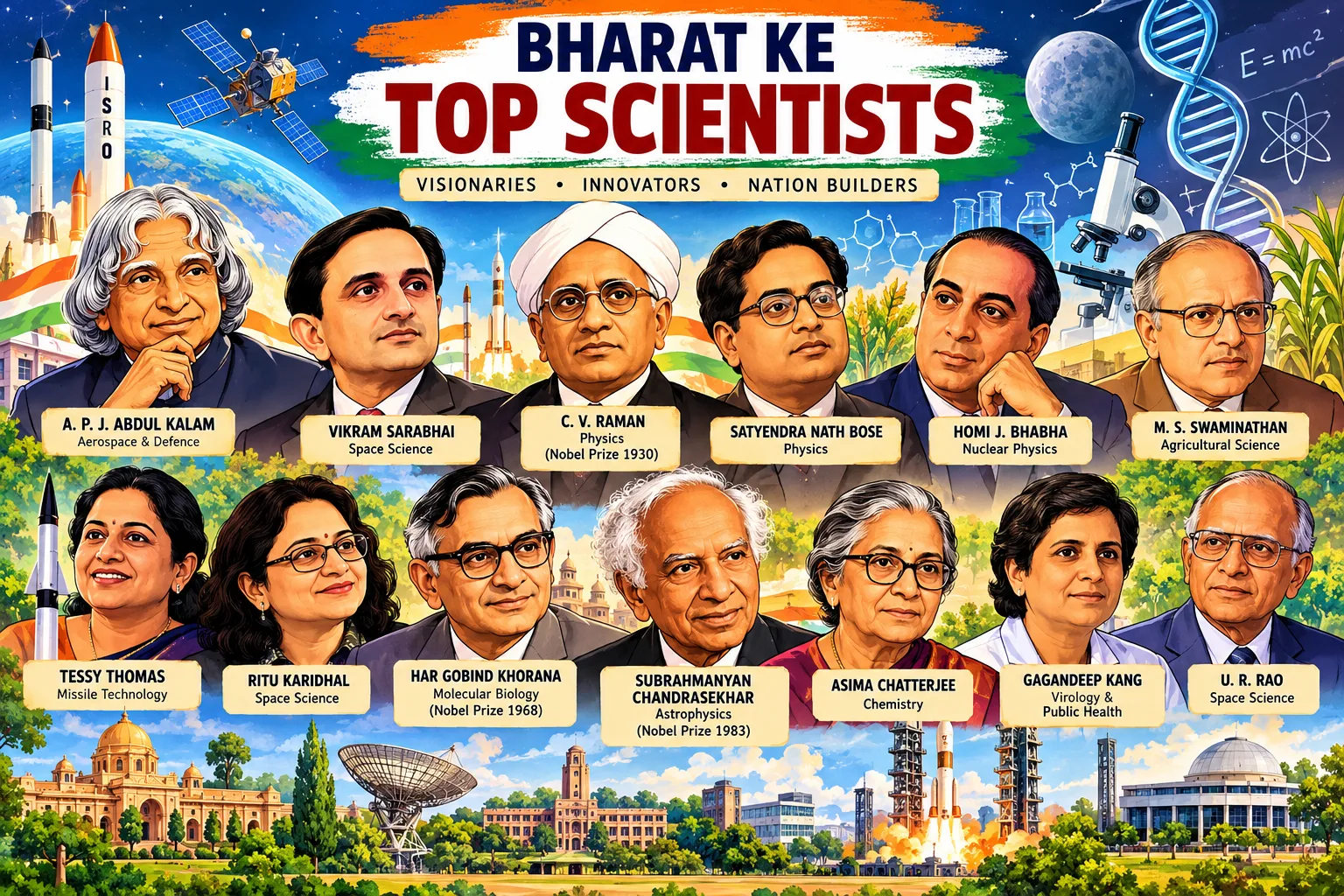
Any country's creation is not just about parliament buildings, big roads, tall buildings, industries, or glittering cities. The real strength of a nation is built by those people who make society a little better with their knowledge, labor, courage, honesty, service, and sacrifice. Some of these people's names are recorded in history books, but many of them change the lives of thousands of people and yet their names do not reach the common people.
These are the people who are actually the real makers of the country.
Nation-building is not just the job of people in big positions
Often when we hear the word "nation-building", we think of the Prime Minister, President, big leaders, or famous industrialists. Certainly, these positions and people have their important roles, but a country's progress is not just about decisions made from above.
The real building of a nation starts from below.
That teacher who teaches children in a small village and instills in them the courage to dream, is building the nation. That doctor who treats poor patients in an area with limited resources, is building the nation. That farmer who develops new agricultural techniques and increases the income of other farmers, is also building the country.
The soldier standing at the border, the scientist doing research in a laboratory for years, the environmental activist saving the forest, the person reviving a pond in a village, the ordinary citizen saving the lives of unknown people in an accident— all of these are part of the same long chain of nation-building.
The identity of a real hero is not fame, but contribution
In today's time, popularity is often considered as success. The one who has millions of followers, whose videos go viral or who is constantly seen in the media, is considered influential.
But being famous and being useful are two different things.
A scientist may work in a laboratory all his life and common people may not even recognize his face, but his discovery can change the lives of millions of people. A rural woman may spend years educating and empowering women in her area, but she may not even have a social media account. A teacher can change the direction of thousands of children in his life and yet may never be famous outside his district.
So, a person's greatness should not be measured by their followers or headlines.
Being famous is not a condition for being great. Contribution does.
Who are the people who actually build the country?
In the construction of a vast and diverse country like India, thousands of types of people contribute. These include specially those who:
Knowledge and science boundaries are pushed forward by scientists, researchers, engineers and innovators; People's lives are saved and improved by doctors, nurses, healthcare workers and public-health professionals; Children and youth are educated by teachers, professors and grassroots educators; Our safety is ensured by soldiers, police personnel, firefighters, rescue workers and disaster-response teams; Farms, water and nature are protected by farmers, agricultural innovators, environmentalists and water conservation workers; Society's weak and neglected people are worked for by social workers and community volunteers; India's languages, folk arts, traditions and cultural heritage are preserved; Sports represent the country, especially those players who receive very little mainstream attention; And those ordinary citizens, who show extraordinary courage in extraordinary circumstances.
Each of these individuals may have a different contribution, but there is a similarity between them - their work is not limited to just their own lives. Its benefits reach other people.
Scientists and innovators make the country's future
India's scientists have shown us that the power of a nation is not just made up of natural resources, but of knowledge.
C. V. Raman's science, S. N. Bose's contribution to theoretical physics, Vikram Sarabhai's vision for the space programme, Homi Bhabha's contribution to nuclear science, M. S. Swaminathan's work in agricultural science, and A. P. J. Abdul Kalam's contribution to aerospace and defence technology - all these have strengthened India's capabilities.
But along with them, there are thousands of lesser-known researchers and grassroots innovators who have made discoveries that solve local problems.
Sometimes a farmer develops a new crop variety. A rural innovator creates a machine that makes the work of small farmers easier. A scientist develops a medical technique that is affordable and accessible.
Such innovations are equally important because they arise directly from people's problems.
The teacher lays the foundation of the nation
If one profession is given the longest-term role in nation-building, then perhaps the teacher is the best example.
A good teacher not only teaches mathematics, science, or language. He develops curiosity, discipline, confidence, and values in a child.
A teacher's classroom can produce future scientists, soldiers, doctors, engineers, artists, administrators, and entrepreneurs.
Therefore, the contribution of a teacher working in a remote village can be equally important as that of a professor sitting in a big institution.
Especially those teachers who work with tribal areas, border regions, economically weaker communities or special-needs children, are working on that part of nation building where patience and dedication are needed the most.
Doctors not only cure diseases, but also trust
An important part of nation building is—keeping people healthy.
When a doctor treats poor patients for decades at low fees, a surgeon saves lives in difficult situations, or a public-health worker provides vaccination and health awareness in remote areas, he is not just providing medical service.
He is creating security and trust in society.
There have been many such doctors and health workers in India who have made rural and underserved communities the center of their service, rather than big hospitals or cities.
Their story reminds us that medicine is not only a profession, but also a service.
Farmers and environmental protectors are also nation builders
A large part of India's civilization and economy is connected to land, water and agriculture.
Therefore, the farmer who develops new farming techniques, creates drought-resistant crops or finds a way to farm with less water, is directly contributing to nation building.
In the same way, people who revive ponds, protect forests, save biodiversity, and work on water conservation secure resources for future generations.
Their work may not be immediately visible in a city, but its impact can last for decades.
Soldiers and rescue workers keep us safe
Some people build a nation and some people protect that nation.
Soldiers posted on the border, personnel fighting against terrorism or insurgency, rescue workers who save people during disasters, and ordinary citizens who risk their lives to save a stranger—all of their contributions are not limited to just one event.
They maintain the trust in society that during difficult times, someone will stand up for us.
Often, the greatest bravery is not shown in front of a camera, but in that moment when a person has to decide whether to stay safe or move forward to save someone else.
Both famous and unknown people are essential in nation-building
We should definitely read the stories of India's great scientists, leaders, soldiers, and social reformers.
But if our stories are limited to only famous people, the real picture of India will remain incomplete.
India is also built in villages.
India is also built in mountains.
India is also built in forests, islands, border districts, and tribal regions.
India is also built in that small classroom where a teacher is teaching ten children and in that small clinic where a doctor is treating a poor family.
The country is not made up of only those people whose names we know.
Many times the country is made up of those people whose names we have yet to know.
The purpose of Bharat ke Asli Heroes
Bharat ke Asli Heroes – the purpose of India's real heroes is to bring out the stories of such people.
We do not just want to make a list of famous names.
We want to find the stories of scientists, doctors, teachers, soldiers, farmers, athletes, social workers, innovators, environmentalists, artists and ordinary citizens whose contributions are real and verified.
We try to make every story based on inspiration as well as evidence.
Because the coming generations do not just need heroes.
They need true role models.
And perhaps the best definition of nation-building is:
The country is built by those people who leave their part of India a little better than before through their work.
These are India's real heroes.
 All posts →
Comments
Log in to commentNo comments yet. Start the conversation.