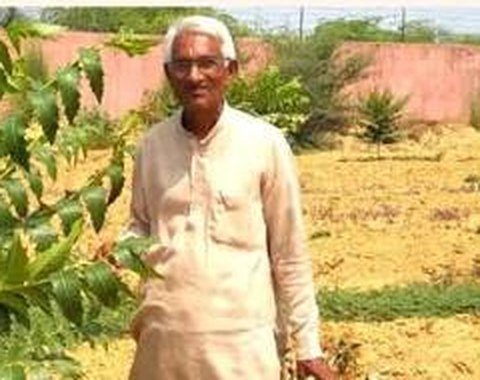
Choosing the field over a job
Sundaram Verma comes from a farming family in Danta village, in Rajasthan’s Sikar district. He finished a science degree around 1972. By his own account and reports from the time, he was selected for government science-teacher posts but chose farming and field experiments instead. The Department of Science and Technology (DST) confirms that he chose on-farm research despite having a job offer.
His exact date of birth is not on record. Government material from 2020 gave his age as 68.
1982: the training that changed direction
In 1982 the Rajasthan Agriculture Department sent him to a Young Farmers training course at IARI, Pusa, in New Delhi. There he learned the principles of dry farming, especially the idea of saving moisture in the soil. But those methods did not fit Rajasthan’s very low rainfall as they were, so he began adapting the idea to trees.
His first plantings did not do well, and few saplings survived without irrigation. Then, in 1982, some saplings went in late, after the monsoon, and he noticed that some survived better than expected. That raised a question: if the topsoil could be stopped from losing moisture, could the roots reach the monsoon water stored deeper down? He spent years running careful experiments to find out.
How the one-litre method works
The method saves the monsoon rain inside the soil and lets the young tree draw on it. First the field is levelled so that rainwater soaks in instead of running off. After the rain, the field is ploughed deep. This removes weeds that would drink the moisture, and it breaks the fine channels in the topsoil through which water rises to the surface and evaporates.
Near the end of the monsoon the soil is prepared again, and the sapling is planted deeper than usual so that its roots quickly head down towards the moist layer. At planting, it gets about one litre of water. After that there is no regular watering: the tree lives on the moisture stored below and on later rain.
Does it work?
Different sources give different survival rates, from about 80% to close to 100%. The most useful evidence is a 2022 field study at several sites in Sikar using Ardu, Shisham, Neem, Rohida, Moringa, Ber and Khejri. On the plots studied, Shisham, Rohida, Ber and Khejri all survived. Ardu, Neem and Moringa mostly survived at 90% or more, though harsh cold and wind killed some plants at some sites.
The study concluded that these local species can be grown with the one-litre method, and also said that location-specific trials are needed before recommending it widely. So the honest summary is that many native species have survived very well, and the results depend on the species, the site and the weather.
More than 50,000 trees
DST and the Rajasthan government both record that more than 50,000 trees were grown in the arid Shekhawati region with his method. They include local, useful species such as khejri, neem, rohida, ardu, ber, babul and shisham. An older case study had already counted more than 21,000 plantings by August 2007.
A Parliament research booklet adds that he set up six nurseries and gave about 1.5 lakh saplings to other farmers, along with training in the method. These are two different measures, trees grown and saplings shared, and they should not be added together.
A farmer who breeds crops
Trees are only part of his story. According to DST, his improved Kabuli chana variety SR-1 was registered with the Protection of Plant Varieties and Farmers’ Rights Authority. It is described as having medium-bold seeds, higher test weight, higher yield and resistance to pests.
He also worked on Guar SR-23, suited to arid and semi-arid conditions, and Moth bean SR-1, a short-duration selection of about 60–65 days with better yield and resistance to pests and disease. He has kept many local crop varieties alive too. For him, the goal was never only more production; protecting the diversity of crops was central.
“Biodiversity is the soul of nature and our future.”
Sundaram Verma
Finding other innovators
Around 1995, at an agricultural workshop in Jaipur, he met Prof. Anil K. Gupta and joined the Honey Bee Network. From then on he did not only spread his own idea; he went looking for other grassroots inventors. He was among the National Innovation Foundation’s early collaborators and became a member of its General Body.
DST names innovators he helped discover in Rajasthan, including Jagdish Parikh, Santosh Pachar, Madanlal Kumawat, Subhash Ola, Yusuf Khan and Rai Singh Dahiya, several of whom later won national grassroots innovation awards. An archival GIAN case study reports that he gathered more than 10,000 examples of innovation and traditional knowledge from about 1,500 people in Rajasthan.
Honours along the way
His work was recognised long before the Padma Shri: the ICAR Jagjivan Ram Farmer Award in 1997, the Van Pandit Award from the Government of Rajasthan and a Best Farmer state award in 1998, the Chaudhary Charan Singh Krishak Shiromani National Award in 2003, and a national award for biodiversity conservation in 2007.
His Padma Shri was announced in 2020 in the Social Work category. President Ram Nath Kovind presented it on 9 November 2021.
Still taking root
The method is still in use. A March 2025 NDTV Rajasthan ground report from Devrod in Jhunjhunu district described about 7,500 saplings planted under his guidance at the Mukti Dham. About a year and a half later, many had grown to roughly ten feet.
Watch
Sources
- DST / PIB: 'Journey of an innovator to an innovation influencer'
- Gazette of India: Padma Awards 2020
- Parliament PRIDE research booklet
- Rajasthan government innovation record
- ICFRE SLEM practitioners database
- ICAR-CAFRI Agroforestry Success Stories
- GIAN / Honey Bee Network case study
- Field evaluation study, Sikar (2022)
- NDTV Rajasthan ground report, March 2025
- dst.gov.in/journey-innovator-innovation-influencer