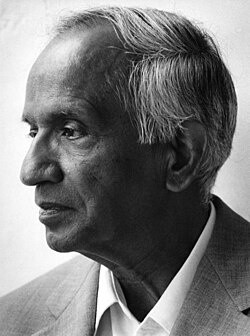
A calculation at sea
Subrahmanyan Chandrasekhar was born on 19 October 1910 in Lahore. He was C. V. Raman’s nephew, but his own scientific identity was entirely independent and deep. After studying at Presidency College, Madras, he went to Cambridge.
On the sea voyage itself, he began combining relativistic effects with quantum statistics to calculate the mass limit of white dwarf stars.
About 1.4 suns
He showed that a white dwarf cannot remain stable above about 1.4 solar masses. This became the Chandrasekhar Limit, a key to understanding how stars end, and the starting point for the theory of white dwarfs, neutron stars and the formation of black holes.
Early on, Arthur Eddington publicly opposed his conclusions, a deep professional setback for the young Chandrasekhar. Later understanding of stellar evolution proved him right.
Decades of deep work
He did not abandon research. At the University of Chicago he did seminal work and wrote landmark books on stellar dynamics, radiative transfer, hydrodynamic stability and black holes; his textbooks became standard references for generations of astrophysicists.
In 1983 he received the Nobel Prize. His career is a classic example of scientific resilience: truth in science is not settled by popularity.
Sources
- Nobel Prize: Chandrasekhar biography
- University of Chicago
- Britannica
- nobelprize.org/prizes/physics/1983/chandrasekhar/biographical/
- uchicago.edu/
- britannica.com/biography/Subrahmanyan-Chandrasekhar