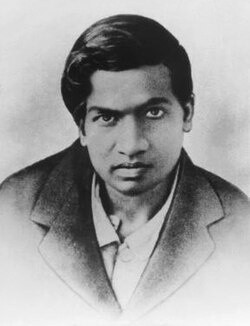
Teaching himself
Srinivasa Ramanujan was born on 22 December 1887 in Erode, Tamil Nadu, and grew up in Kumbakonam. As a teenager he came across G. S. Carr’s synopsis of mathematics, and from there, largely self-taught, he developed thousands of identities and results.
He neglected other subjects in the formal curriculum, so his college education was interrupted, and money was short. Working as a clerk in Madras, he kept writing mathematics in his notebooks.
A letter to Cambridge
In 1913 he sent his results to the Cambridge mathematician G. H. Hardy. Hardy recognised his genius and invited him to England. Before that, recognition at home had been limited; the right mentor and institution gave his talent a world stage.
Between 1914 and 1919 Ramanujan did remarkable work on partitions, modular forms, continued fractions, infinite series and highly composite numbers. In 1918 he became a Fellow of the Royal Society.
A short life, a long legacy
Ill health brought him back to India in 1919, and he died on 26 April 1920, only 32 years old.
His formulas and conjectures deeply shaped analytic number theory, q-series, modular forms and combinatorics; research on his mock theta functions is still active, with links to modern mathematics and physics. His notebooks were a source of new results for decades. India celebrates 22 December as National Mathematics Day.
Sources
- MacTutor: Srinivasa Ramanujan
- Royal Society
- Government of India: National Mathematics Day
- mathshistory.st-andrews.ac.uk/Biographies/Ramanujan/
- royalsociety.org/