A job and a mission
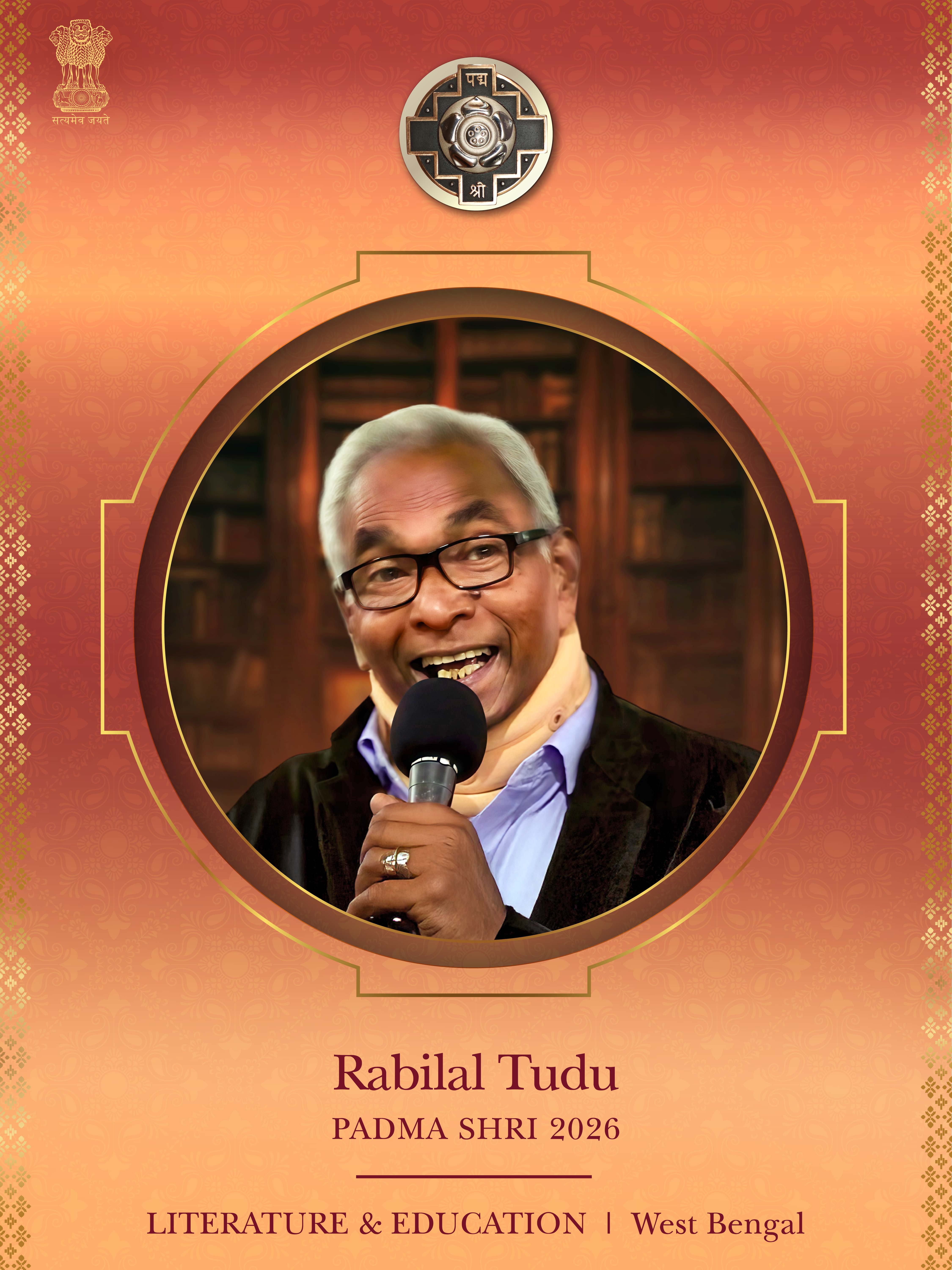
Rabilal Tudu’s story is about a writer who kept his mother tongue, Santali, at the centre of his work even while he held a bank job. According to the Government of India’s 2026 Padma citation, he was born on 21 December 1949 in the Bardhaman region of West Bengal.
After graduating from Kalna College in 1972, he worked in the office of the Accountant General, West Bengal, and later became an Assistant Manager at Central Bank of India. Alongside his job, he kept writing plays, stories and pieces on social questions in Santali.
Plays for the stage and the air
Language in crisis, community, folk memory and social strain come up again and again in his writing. The official citation names Parsi Khatir as his major work; that play won him the Sahitya Akademi Award in 2015.
Works such as Bir Birsha, Somaj Bairi and Sardi Sengel reached people both on stage and on radio. Some of his plays found a place in university syllabi, so his writing did not stay inside literary circles; it became teaching material too.
Recognition, and a goodbye
He was associated with the Sahitya Akademi’s Santali Advisory Board and contributed to efforts to promote Santali writing in West Bengal. He received the Banga Bhushan in 2022.
The Padma Shri was announced in January 2026. He died on 4 June that year, and the later official citation recorded the award as posthumous.
His life shows that the strongest way to save a language is to keep it active in everyday life, on stage, on radio and in education.
Sources
- PIB / Padma Awards 2026: official citations
- Padma Awards 2026: notification
- Ministry of Tribal Affairs: video profile
- static.pib.gov.in/WriteReadData/specificdocs/documents/2026/jun/doc2026623901101.pdf
- padmaawards.gov.in/Document/pdf/notifications/PadmaAwards/PadmaAwards2026.pdf
- youtube.com/watch?v=VJ6_i2vP4rU