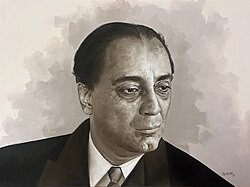
A physicist in the making
Homi Jehangir Bhabha was born on 30 October 1909 in Bombay, into an educated Parsi family. He was sent to Cambridge to study engineering, but his heart was in theoretical physics.
His research on cosmic rays and particle physics won him international recognition. Bhabha scattering and cosmic-ray cascade theory are well-known contributions to high-energy physics.
Stranded, then building
During the Second World War he remained in India and joined C. V. Raman at IISc Bangalore. He saw that an independent India needed not just individual scientists but world-class institutions.
The Tata Institute of Fundamental Research was founded in 1945, and Bhabha played a central part in creating the Atomic Energy Commission and the Department of Atomic Energy. He saw nuclear energy as a long-term national capability.
A legacy of institutions
His institution building laid foundations for talent in nuclear science, electronics, mathematics, computing and the space era. The Atomic Energy Establishment at Trombay later became the Bhabha Atomic Research Centre.
He died in 1966 in the Air India Flight 101 crash. His life shows that great science is made not only by discoveries, but by institutions too.
Sources
- BARC: About
- TIFR: history
- Department of Atomic Energy
- barc.gov.in/about/
- tifr.res.in/
- dae.gov.in/