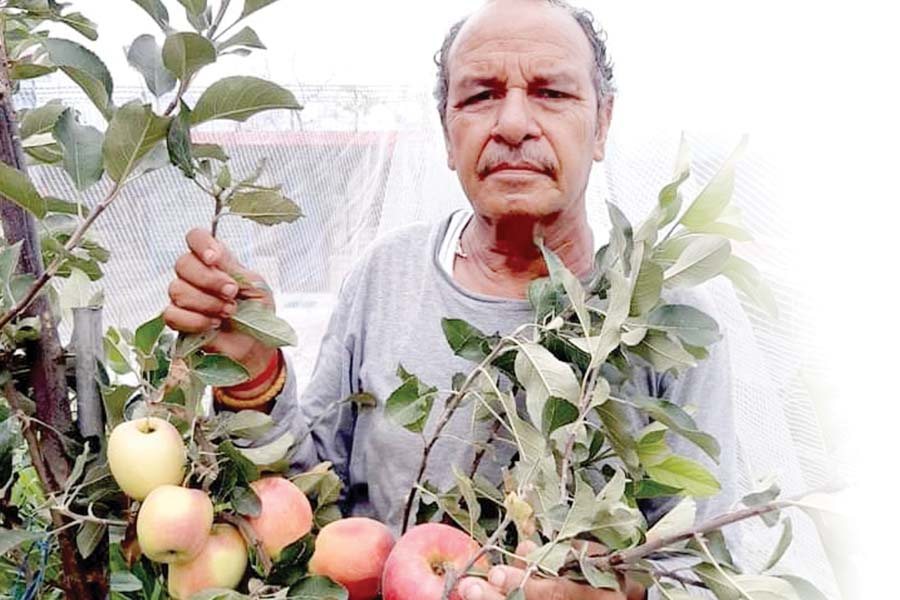
A hard beginning
Hariman Sharma was born on 4 April 1956 in Bilaspur district, Himachal Pradesh. By his own account, his mother died just three days after he was born, and he was raised by Ridku Ram of Paniala village. Government records confirm that he lost his parents as a child, was brought up by a relative and studied up to Class 10.
He never went to an agricultural university or worked in a laboratory. In his own telling, his early years were spent doing daily-wage work, breaking stones and growing vegetables, and later building a mango orchard. That is the background from which one of India’s most talked-about farmer innovations would come.
1998: a few seeds thrown in the backyard
In 1998 he bought some apples in Ghumarwin and brought them home. After the family ate them, the seeds were thrown into the backyard. The next year, in 1999, he noticed an apple seedling growing there.
Paniala sits at about 1,800 feet and is a warm place. Commercial apples usually need long periods of cold. So instead of pulling the plant out, he let it grow. In 2001 it bore fruit. The real question was no longer how a seed had sprouted. It was how an apple tree had set fruit at such a low height, in such a warm climate.
Years of patient work
He protected the original tree as a mother plant and began grafting. With no apple rootstock at hand, he first grafted a branch onto a plum tree. The graft took, and later gave good-quality fruit. Around 2004–05 he brought crab-apple seedlings from Shimla, grafted onto them, and by about 2005 had a small apple orchard.
Growing the trees turned out to be the easy part. From 2007 to 2012 he kept trying to convince farmers, horticulturists and experts that apples could be grown in low-chill conditions. For years, the response was limited.
Science steps in
Around 2012–13 the National Innovation Foundation (NIF) took up his work. It arranged molecular and diversity analysis, fruit-quality tests, morphological studies, SSR DNA fingerprinting and trials at many locations.
According to the Indian Council of Agricultural Research (ICAR), these studies showed that HRMN-99 is distinct from other low-chill varieties such as Anna and Dorsett Golden. A farmer’s claim had now been tested and confirmed by science.
What is HRMN-99?
Government records describe HRMN-99 as a self-pollinating, low-chill apple. It does not need the long cold spell that most commercial apples need, and in trials it has fruited in the plains and in tropical and subtropical places, including areas where summer temperatures reach 40–45°C.
The fruit has red stripes over a yellow skin and a soft, sweet, juicy pulp. Field data from 2021 recorded 5 to 75 kg of fruit per plant each year from trees three to eight years old.
From one backyard to the whole country
Between 2014 and 2019, NIF sent more than 20,000 saplings to over 2,000 farmers’ fields and 25 organisations for trials. By 2021 the variety had been tried in 30 states, with fruit reported in 23 states and union territories. Rashtrapati Bhavan was one of the trial sites.
Manipur became an important example. In 2015, 26 farmers began growing it at eight locations; about 200 more farmers joined later, and more than 20,000 HRMN-99 plants were reported there. By 2025, official reports put its reach at 29 states and UTs, with more than one lakh saplings planted in the Northeast.
A farmer’s variety, on record
HRMN-99 is more than a nickname. It is registered under India’s Protection of Plant Varieties and Farmers’ Rights framework as Malus domestica HRMN 99, with Hariman Sharma as the farmer, under reference REG/2014/1282. ICAR’s Central Institute of Temperate Horticulture in Srinagar was part of its testing.
That makes him more than ‘the Apple Man’. He is a recognised developer of a farmer’s variety.
Recognition, slowly
The seedling appeared in 1999. The national honour came in 2025. In between, recognition grew step by step: the National Innovative Farmer Award in 2016, a National Award from President Pranab Mukherjee at NIF’s 9th National Biennial Grassroots Innovation Awards in 2017, and the ICAR-Jagjivan Ram Abhinav Kisan Puraskar in 2020. In 2023 he represented India at the 4th ASEAN-India Grassroots Innovation Forum in Malaysia.
On 25 January 2025 the Government of India announced his Padma Shri in the field of agriculture. He received it at the civil investiture ceremony on 28 April 2025.
Why his story matters
The heart of this story is not the award. It is what a farmer with a Class 10 education did with one unusual observation. He noticed a plant most people would have pulled out as a weed. He kept at it for years without support. He let scientists test his claim instead of asking to be believed. And he helped take the result to thousands of other farmers.
Good agricultural ideas do not only come from laboratories. Sometimes they start in a backyard.
Watch
Sources
- President of India: Padma Shri citation
- DST / PIB profile, 2021
- DST / PIB, 2025
- ICAR award citation, 2020
- National Innovation Foundation: 9th Biennial profile and 2025 newsletter
- ICAR-CITH, Srinagar
- The Indian Express interview
- Hariman Sharma Apple Nursery (his own website)
- dst.gov.in/padma-shri-hariman-sharma-apple-man-india