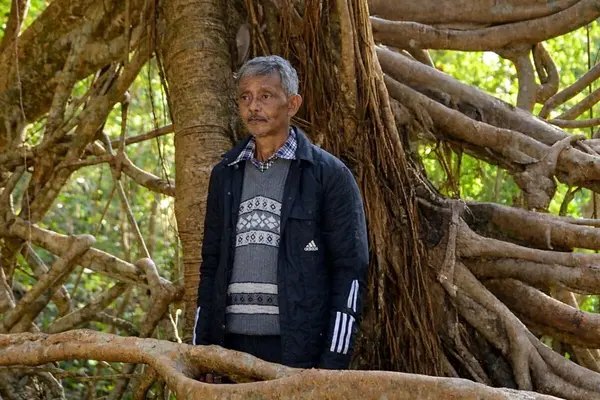
Growing, not building
Hally War’s story is not about constructing a bridge. It is about growing one over decades. Meghalaya’s Khasi people make living root bridges, Jingkieng Jri, by guiding the aerial roots of the rubber fig tree (Ficus elastica). According to his official Padma citation, Hally War was born on 5 February 1957 and has been part of this indigenous craft of living engineering since he was about ten.
The Umkar bridge
In Siej village, Sohra, he has carefully guided, woven together and nurtured aerial roots over streams and river crossings. His best-known work is the Umkar living root bridge. Unlike a concrete bridge, it has no single day of completion: the roots take years, even decades, to grow strong, join together and carry weight. That makes his work a rare example of engineering built on patience.
Knowledge from his father and grandfather
On a PIB press tour in September 2026, War explained to journalists how the roots are guided and tended over many years, and said he learned this from his father and grandfather. So this is less a personal invention than the care and passing-on of knowledge across generations. The citation also notes his influence through teaching younger families, building ecological resilience and supporting sustainable tourism.
He is also a farmer, growing betel nut, betel leaf, black pepper and fruit, so his knowledge of nature is part of daily life on the land. The Padma Shri gave national recognition to a man who had worked for decades, largely unseen, behind one of Meghalaya’s best-loved sights.
Sources
- PIB / Padma Awards 2026: official citation
- PIB: Padma Awards 2026
- PIB (Sep 2026): press tour report
- Guwahati Plus: Hally War named for Padma Shri
- static.pib.gov.in/WriteReadData/specificdocs/documents/2026/may/doc2026525876101.pdf
- pib.gov.in/PressReleasePage.aspx?PRID=2218580&lang=2®=3
- pib.gov.in/PressReleasePage.aspx?PRID=2312200&lang=2®=48
- guwahatiplus.com/hally-war-named-for-padma-shri-for-preserving-meghalayas-living-root-bridges