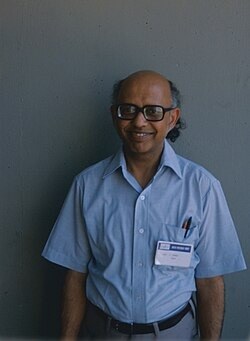
Listening to the radio sky
Govind Swarup was born on 23 March 1929 in Thakurdwara, Uttar Pradesh. After studying physics he went to Australia and the USA to train in radio astronomy.
Despite established opportunities abroad, he returned to India and built a radio-astronomy group at TIFR. Building large scientific instruments at home was a high-risk choice.
A hill and a field of dishes
The Ooty Radio Telescope was built by making clever use of a hill slope in Ooty. Later his leadership was central to conceiving and building the Giant Metrewave Radio Telescope (GMRT) near Pune.
His major contribution was cost-effective design of large radio telescopes, interferometry, in which many antennas work together as one, and infrastructure for low-frequency radio astronomy.
India on the radio-astronomy map
Because of its frequency range and scale, GMRT became a world-class facility. It put India on the global radio-astronomy map and draws international users studying pulsars, galaxies, cosmology and transient events.
Frugal engineering and scientific ambition are not opposites. Local geography and engineering creativity can produce world-class instruments.
Sources
- NCRA obituary: Govind Swarup
- NCRA-TIFR
- GMRT
- ncra.tifr.res.in/ncra/obituary-prof-swarup
- ncra.tifr.res.in/
- gmrt.ncra.tifr.res.in/