From an island town to aeronautics
Few Indian scientists are as widely loved as Dr A. P. J. Abdul Kalam. But calling him only the “Missile Man” or the “People’s President” leaves most of the story out. His path ran from a small island town to India’s own launch vehicles, its missile programmes, national science policy and, in his last years, constant conversations with young people.
According to his official biography, he was born on 15 October 1931 in Rameswaram. He specialised in aeronautical engineering at the Madras Institute of Technology. That training took him first to DRDO and then to ISRO, into the generation of engineers trying to make India self-reliant in launch-vehicle technology.
SLV-III: failure first, then success
At ISRO he was Project Director of SLV-III, India’s first indigenous Satellite Launch Vehicle. The first attempt failed. In July 1980, SLV-III placed the Rohini satellite in near-earth orbit.
Kalam later described what happened after the failure. Satish Dhawan, then head of ISRO, faced the press himself and took responsibility. When the next launch succeeded, Dhawan put Kalam and the team in front of the media. Kalam called it one of the most important lessons of his life: when things go wrong, the leader owns the failure; when they go right, the team gets the credit.
Missiles and strategic technology
At DRDO he was Chief Executive of the Integrated Guided Missile Development Programme. Agni and Prithvi were part of this large, shared effort. From 1992 to 1999 he was Scientific Adviser to the Defence Minister and Secretary of the Department of Defence Research and Development.
During the Pokhran-II period his role was carried out together with the Department of Atomic Energy and many scientific and technical teams. It is not accurate to describe any one person as the creator of the whole programme.
From President back to teacher
From 2002 to 2007 he was the 11th President of India. After leaving office he went straight back to education. He took up academic work at Anna University, kept visiting schools and colleges, and wrote books such as Ignited Minds. That gave him a place of his own as a science communicator and mentor to young people.
He received the Padma Bhushan in 1981, the Padma Vibhushan in 1990 and the Bharat Ratna in 1997. He died on 27 July 2015.
What his story teaches
Team success should not be turned into one person’s achievement. Failure in science is feedback, not the end. Technology leadership is worth most when it serves a public purpose. And recognition does not have to end learning or teaching: Kalam kept doing both until his last day.
Sources
- President of India: official profile of Dr A. P. J. Abdul Kalam
- President of India: Kalam's answers to a foreign journalist (SLV-3 leadership account)
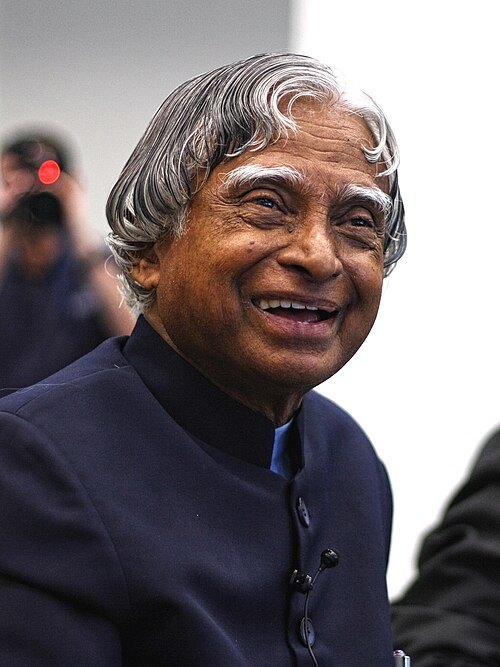
- Wikimedia Commons: photograph by Lijesh K. (CC BY-SA 3.0)
- presidentofindia.gov.in/dr-apj-abdul-kalam-profile
- presidentofindia.gov.in/dr-apj-abdul-kalam/speeches/questionnaire-foreign-journalist
- commons.wikimedia.org/wiki/File:A._P._J._Abdul_Kalam_in_2008.jpg