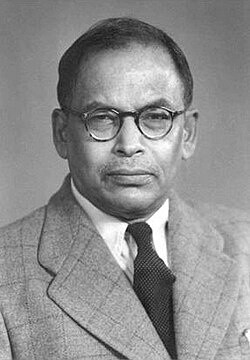
Against the odds
Meghnad Saha was born on 6 October 1893 into a family of modest means in Dhaka district. Despite money troubles he kept studying, and at Presidency College he was among brilliant contemporaries including Satyendra Nath Bose.
Scholarships and academic excellence carried him past poverty and the limits of the colonial education system, and short research stays abroad linked his ideas to the international scientific network.
One equation for the stars
Around 1920 he developed the theory of thermal ionisation, now called the Saha ionisation equation. It gave a quantitative link between temperature, pressure and the ionisation states of atoms.
It explained, through thermodynamics and atomic physics, why the spectral lines of different elements appear or disappear in stellar atmospheres. It is counted among the foundational equations of modern astrophysics.
A scientist in public life
Saha taught and researched at the universities of Allahabad and Calcutta, built scientific institutions and journals, took an interest in river planning and national science policy, and later became a Member of Parliament. The Saha Institute of Nuclear Physics carries his name.
He is one of the earliest examples of a scientist with a public-policy role: scientific knowledge, his life suggests, is not separate from public policy.
Sources
- INSA: Meghnad Saha
- INSA Biographical Memoir
- Saha Institute of Nuclear Physics
- insaindia.res.in/07062023_no.php?id=F00-0688
- insaindia.res.in/BM/BM2_7008.pdf
- saha.ac.in/