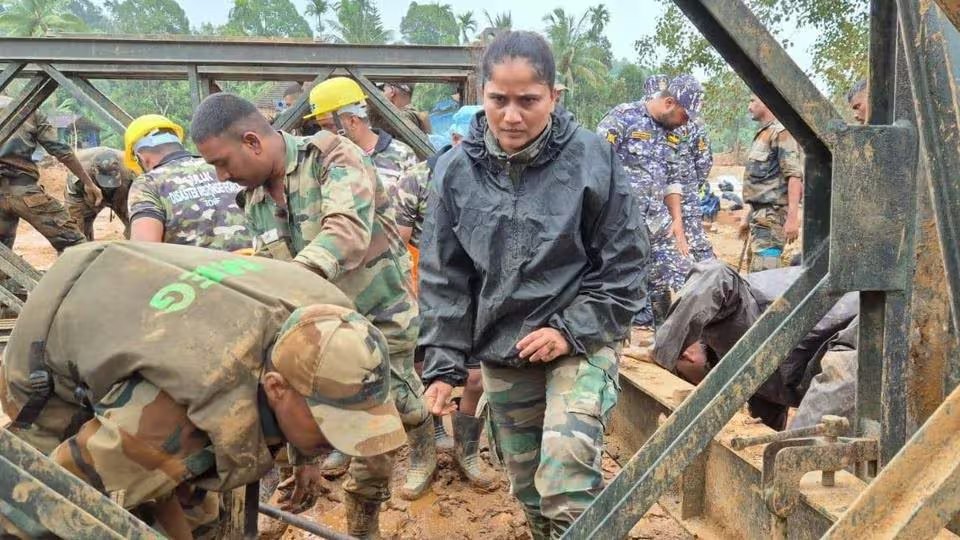
A viral photo, and the real story
After the Wayanad disaster, photographs of Lt Col Seeta Ashok Shelke spread widely, often with lines like “woman officer built the bridge”. The official record tells a stronger and more accurate story. As part of an Army engineering team, she led and supervised high-risk rescues, coordination with civil authorities and the construction of a 190-foot Bailey bridge at Chooralmala.
Wayanad, 2024
According to the official 2026 award citation published by PIB, she led large humanitarian assistance and disaster relief operations during the Wayanad floods and landslides. She coordinated evacuation, relief distribution and the restoration of essential services with civil authorities and local leaders. Several rescue missions were carried out in bad weather on unstable ground.
190 feet across the gap
With Chooralmala cut off, putting up a 190-foot Bailey bridge quickly became a crucial part of the operation. The citation says she supervised the construction and directed engineering improvisations in difficult site conditions. A Komatsu PC210 excavator was used as a counterweight, and a temporary footbridge was built at night within four hours.
When standard tools are not enough at a disaster site, field engineering shows its value. Using an excavator as a counterweight and building an improvised footbridge in the dark are less about textbook solutions and more about judgement on the spot.
Giving the team its due
No single person built this bridge. It was a collective operation by Army engineers, sappers, logistics personnel and many agencies. Shelke’s particular role was in leadership, coordination and engineering execution. The viral “one woman built the bridge” framing distorts both her team’s work and how military engineering actually happens.
Recognition
In 2026 she received the Subhash Chandra Bose Aapda Prabandhan Puraskar in the individual category. The citation also links her work to the growing role of women officers in practical disaster-risk reduction, and records that she has trained more than 2,300 personnel in disaster response and humanitarian operations.
Her story shows that in disaster response, leadership means moving fast without giving up on safety, and that engineering knowledge can become a life-saving tool when access has to be restored.
Sources
- PIB: Subhash Chandra Bose Aapda Prabandhan Puraskar 2026 citation
- Hindustan Times: Lt Col Seeta Shelke awarded Aapda Puraskar for leading Wayanad rescue ops
- pib.gov.in/PressReleasePage.aspx?PRID=2217527&lang=2®=48
- hindustantimes.com/india-news/lt-col-seeta-shelke-awarded-aapda-puraskar-for-leading-wayanad-rescue-ops-101769160901672.html