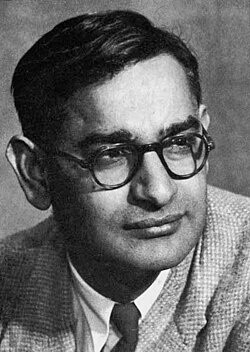
A patwari’s son
Har Gobind Khorana was born on 9 January 1922 in Raipur, Punjab, now in Pakistan. His father was a village patwari who valued education highly.
After studying at Punjab University, he went to the University of Liverpool on a scholarship and earned his PhD. For a family of limited means, education changed the whole course of his life.
Reading the code
After research in Europe and Canada, his laboratory in Wisconsin focused on the chemistry of the genetic code. Alongside the complementary work of Marshall Nirenberg and Robert Holley, Khorana used synthetic RNA sequences and controlled biochemical systems to show which nucleotide triplets specify which amino acid.
His strategy of building defined sequences let the code be mapped systematically. In 1968 the three scientists shared the Nobel Prize.
Making genes
Later, Khorana’s group did pioneering work on synthetic genes and the biology of membrane proteins. Genetic engineering, synthetic biology and molecular diagnostics today rest on ideas in whose history he holds a leading place.
His life shows how precision and tool-building speed up scientific breakthroughs, and how early investment in education can carry talent to a global stage.
Sources
- Nobel Prize: H. G. Khorana
- MIT
- Britannica
- nobelprize.org/prizes/medicine/1968/khorana/biographical/
- mit.edu/
- britannica.com/biography/Har-Gobind-Khorana