From crystals to proteins
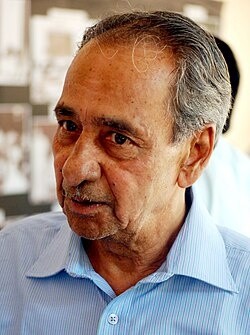
Gopalasamudram Narayanan Ramachandran was born on 8 October 1922 in Ernakulam. With a background in physics, he came to crystal physics under the influence of C. V. Raman.
At the University of Madras he built a strong biophysics group. His team proposed an important model of the triple-helical structure of collagen, a landmark piece of work.
Which shapes are allowed?
A protein is a long chain, and its backbone can twist at two angles, called phi and psi, at every link. To find out which shapes a chain can physically take, Ramachandran and his colleagues systematically analysed where atoms would come too close and collide.
Drawn as a map of the two angles, this showed allowed and forbidden regions. It came to be called the Ramachandran plot, and it is fundamental to crystallography, protein modelling, molecular dynamics and structure validation.
Geometry over expensive machines
With limited international resources, he did globally competitive work on protein structure using geometry, computation and physical reasoning. He also worked on ideas in mathematical imaging and tomography, and his group put India on the early map of molecular biophysics.
Structural-biology laboratories around the world still use the Ramachandran plot. Simple geometric constraints can explain complex biological structures.
Sources
- IISc: About G. N. Ramachandran
- IISc Molecular Biophysics Unit
- Protein Data Bank education resources
- mbu.iisc.ac.in/GNR.htm/About_GNR.pdf
- mbu.iisc.ac.in/
- rcsb.org/