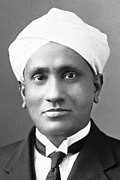
Science after office hours
Chandrasekhara Venkata Raman was born on 7 November 1888 in Tiruchirappalli. From childhood he had an unusual love of mathematics and physics, and he finished his studies at Presidency College, Madras, very young.
Research careers in India were few at the time, so he joined the government finance service. But after work, in the evenings and at night, he kept doing experiments in the laboratory of the Indian Association for the Cultivation of Science. The blue of the sea and the scattering of light held his attention for years.
1928: light that changes
In 1928 his group found that when light passes through a transparent substance, a small part of it scatters with a changed frequency. This came to be called the Raman Effect.
It gave scientists a new way to understand the structure of molecules through scattered light. Today Raman spectroscopy is used in chemistry, materials science, medicines, forensics, geology, nanotechnology and biomedical research, and it shows that a fairly simple optical setup can lead to a fundamental discovery.
A Nobel from India
In 1930 he received the Nobel Prize in Physics, among the first Asian scientists to win a Nobel in science. In colonial India it sent a clear message that world-class fundamental science could be done in India too.
Later, through IISc Bangalore and the Raman Research Institute, he worked to build an independent scientific culture in India. India celebrates National Science Day on 28 February in memory of the 1928 discovery.
Sources
- Nobel Prize: C. V. Raman biography
- Raman Research Institute
- Department of Science and Technology: National Science Day
- nobelprize.org/prizes/physics/1930/raman/biographical/
- rri.res.in/
- dst.gov.in/